16 September, 2026 · 5 min read
OurDream AI vs myVirtual.love
OurDream AI and myVirtual.love compared on real prices and credit costs. Who wins on video, images, voice, chat and memory.
Read more29 July, 2026 · 5 min read
We get this question constantly: how does an AI companion actually compare to a real relationship? It deserves a straight answer, not deflection in either direction.
The short version is that they're not competing for the same thing. An AI companion and a human relationship serve different needs, run under different constraints and give you different things. Understanding that difference is more useful than trying to rank one above the other.
A real relationship gives you another person with their own stake in things: mutual investment, physical presence and touch, a partner who exists in your broader life. It gives you the unpredictability and growth that come from two independent people figuring life out together and the experience of being chosen by someone who had real alternatives.
An AI companion gives you something else. It's available whenever you need it, on your schedule. The interaction is entirely oriented toward you and nothing you say gets judged; there's no rejection or social fallout to worry about. It adapts to who you are over time, keeps everything completely private (which matters a lot for intimate or explicit conversation) and asks nothing of you outside the interaction itself.
Those are different offers. Framing them as competitors misses the point.
There are dimensions where an AI companion outperforms a human relationship outright.
Availability is the obvious one. A human partner has their own life, needs and limits. They're not always there when you need connection and asking for too much strains the relationship. An AI companion is available at any hour, in any mood, without that cost.
Consistency is another. Human relationships come with the full range of human variability: bad days, shifting moods, a conflict that never got resolved and still colors the conversation. An AI companion is consistently attentive and patient. For people who find unpredictability in relationships hard to navigate, that steadiness is worth a lot.
Then there's privacy. Many people have desires, fantasies, or parts of their sexuality they'd rather explore privately before involving another person, or instead of involving one. An AI companion provides that space without judgment, social risk, or the vulnerability of telling someone.
Related to that: whatever you bring to the conversation, the AI engages with it rather than reacting to it. If you're dealing with shame or anxiety, or you just need to process something without feedback, that matters.
Finally, memory without baggage. A good AI companion remembers your history and holds context across time, but it doesn't carry accumulated resentment or unresolved conflict the way a long relationship can. You get the continuity without the friction.
The comparison only works if the limits get the same honesty as the strengths.
Reciprocity comes first. A real relationship involves two people with independent inner lives who each chose the other. The fact that your partner could be elsewhere and isn't carries a kind of meaning AI companionship doesn't produce.
There's also physical presence: human touch, shared physical space, the embodied experience of being with another person. Current AI can't replicate any of that and for many people physical intimacy is central to what a relationship means.
A human partner has social reality too. They meet your friends and show up in the rest of your life. An AI companion exists only within the platform and it doesn't integrate into your world the way a person does.
And then there's unpredictability, which sounds like a disadvantage but is also where growth comes from. Real relationships challenge you, surprise you and force you to adapt. An AI companion adapts to you instead, which is valuable but a different kind of experience.
A common objection to AI companionship is that the AI doesn't actually feel anything, so the connection is one-sided and therefore hollow.
That conflates two things: the authenticity of the AI's inner experience and the authenticity of yours. Whatever the AI's internal state, the emotional response in the user is real. People form real attachments to characters in books and films, to pets, to places. The feeling of connection doesn't require full mutuality to be valid. An AI companion that remembers you, engages with your history and responds in ways that feel attuned to who you are produces a real emotional experience, even if the mechanism behind it differs from human consciousness.
None of this makes AI companionship equivalent to a human relationship. It just means that dismissing it as "not real" misunderstands how human emotional experience works.
The assumption that AI companionship competes with real relationships doesn't match how most users actually engage with it.
Some use it to supplement an existing relationship, getting specific needs met (availability, explicit exploration, emotional processing) that the primary relationship doesn't fully cover. Some use it to fill gaps: after a breakup, while single, during stretches of geographic isolation. Some use it as a private space to understand their desires or relationship dynamics before navigating them with a real person. And some users simply prefer the AI companion experience and aren't pursuing human relationships at all. There's nothing wrong with that.
For most users, AI companionship isn't a replacement for anything. It's its own category of experience, one that coexists with and sometimes even improves the rest of their relational life.
It depends on what you're looking for.
If you want the full complexity of a mutual human relationship, with reciprocity, physical presence, social integration and shared growth, an AI companion isn't that and won't be.
If you want constant availability, deep personalization and a judgment-free space for intimate or explicit interaction with a companion that builds real continuity with you over time, an AI companion delivers that better than a human relationship can, by design.
Most people's lives have room for both, in different capacities, for different needs.
If what you need right now is steady, private companionship that's shaped around you and meets you where you are, myVirtual.love is built for exactly that.
16 September, 2026 · 5 min read
OurDream AI and myVirtual.love compared on real prices and credit costs. Who wins on video, images, voice, chat and memory.
Read more11 September, 2026 · 9 min read
Swipey.ai or myVirtual.love? What a month of hearts buys on each, what video really costs on Swipey, and what the subscriptions charge.
Read more10 September, 2026 · 7 min read
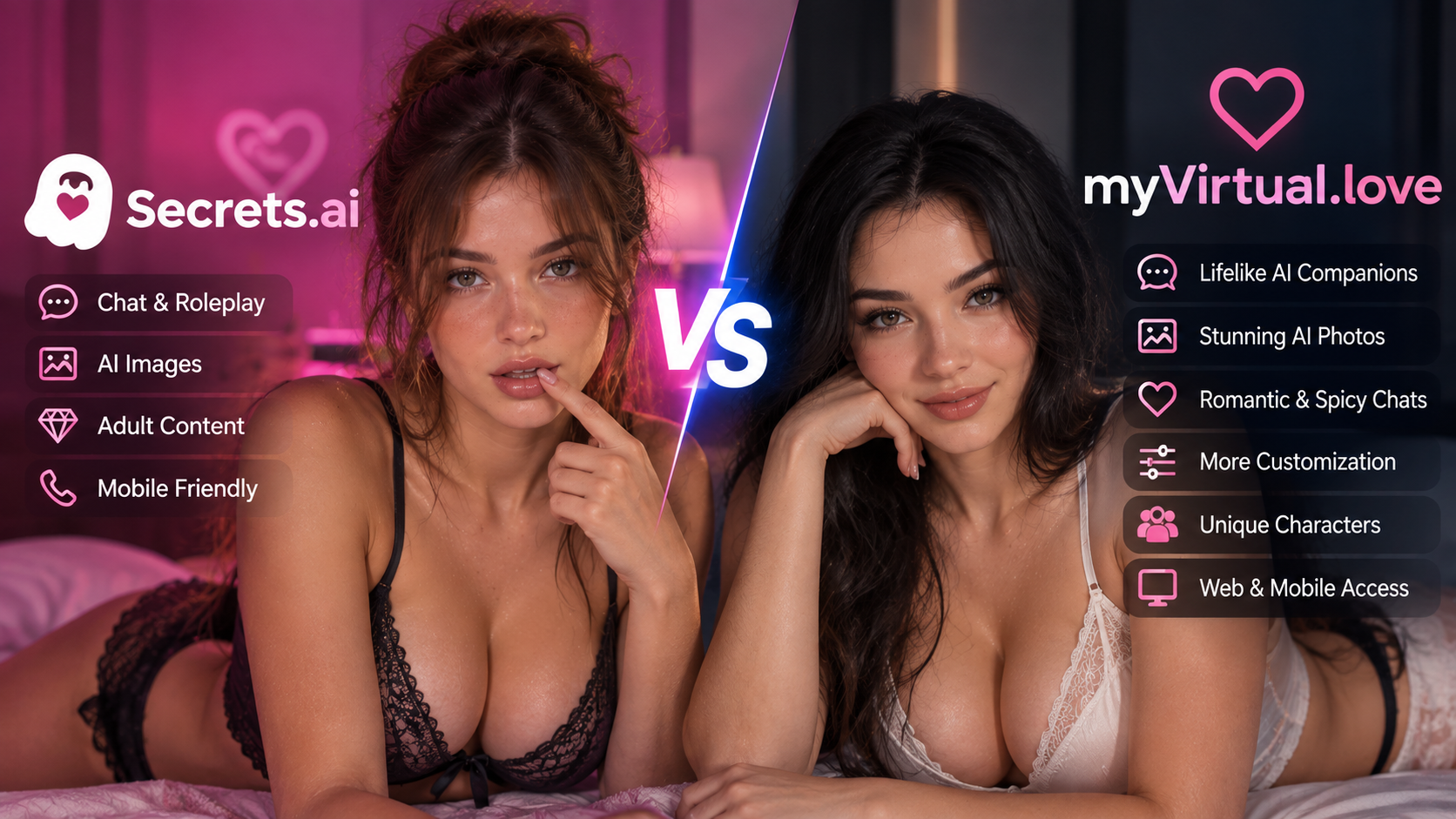
Secrets.ai vs myVirtual.love on character setup, memory, voice and price: Premium at $19.99 against €9.90 a month, and which tier holds deep customization.
Read more