25 September, 2026 · 8 min read
Working From Home Alone
Five calls a day and no real conversation. Who remote-work loneliness hits, the two gaps in a home-office day and what an AI companion can and can't fill.
Read more8 September, 2026 · 7 min read
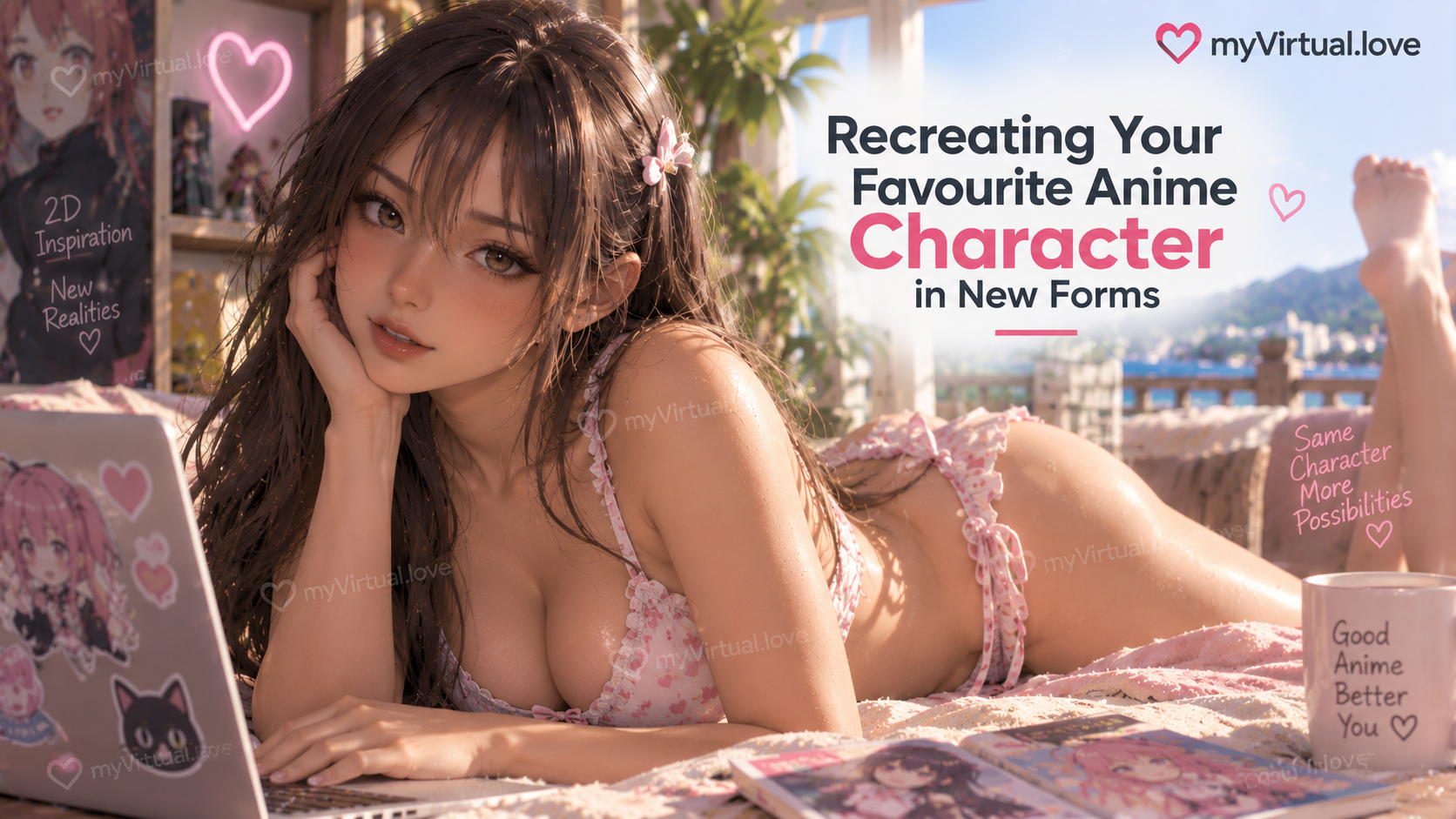
You've watched the series three times. You've read the manga. Your saved folder holds five hundred pieces of fan work. You've probably even cosplayed her. And yet there is still a desire that none of this fully satisfies.
The desire is an old one. Communities form around every anime. Wanting to see a favourite character in new outfits, in new plots, in a new mood, in new interactions, with endings her author never imagined for her is a normal desire, and it is worth naming without judgement.
This piece is for the reader who knows that desire. We'll look at how each existing way of satisfying it helps, what an AI companion adds, and where the whole approach reaches its limits.
Every long-running fandom produces fan art, fan fiction, doujinshi, cosplay, character analysis videos, fan edits and playlists. They exist because canon is finite, but affection for the character is not. You watched twelve episodes with her in them. You wanted a thirteenth. That is exactly what everything on this list is trying to give you.
Fan art is the shortest route to a new look for a heroine. It's vast, varied and often free. You can see her drawn by hundreds of artists, in outfits she never wore in the original and in scenes the original never showed. On a good day, an artist catches something in her that the original never quite confirmed, and you get a version that feels more like her than the official one.
What fan art doesn't give you is any version of her that speaks to you. It is other people's interpretations of her, collected into a scroll. It's a huge gift, but of one specific kind.
Fan fiction is the same impulse at greater length. Alternate universes. Pairings that don't exist in the original. Endings the author refused to write. A single well-written fic can put her in a room, in a conversation, in a slowly unfolding scene the original series would never have found time for.
Fan fiction is the closest most fans get to spending extended time with a character in a situation they chose. What it doesn't give you is the character reading what you wrote today and reacting to that. Fan fiction is written by a stranger for many strangers. It is generous, but it still stands between you and her.
This is where the modern fan often ends up. Public chatbot platforms let users create bots that imitate named characters. You can talk to a bot tagged with her name and get replies that try to sound like her.
If what you want is her name at the top of the chat and replies written in her voice, these platforms deliver exactly that. They also have real limits. Memory between sessions is patchy or thin. Image generation for the character is often not part of the same tool. And imitating a character who is someone else's intellectual property sits in a legal grey area that no serious product can build on for long without running into trouble.
You can use them. Millions of people do. Being upfront about what they are helps more than pretending they are the perfect solution.
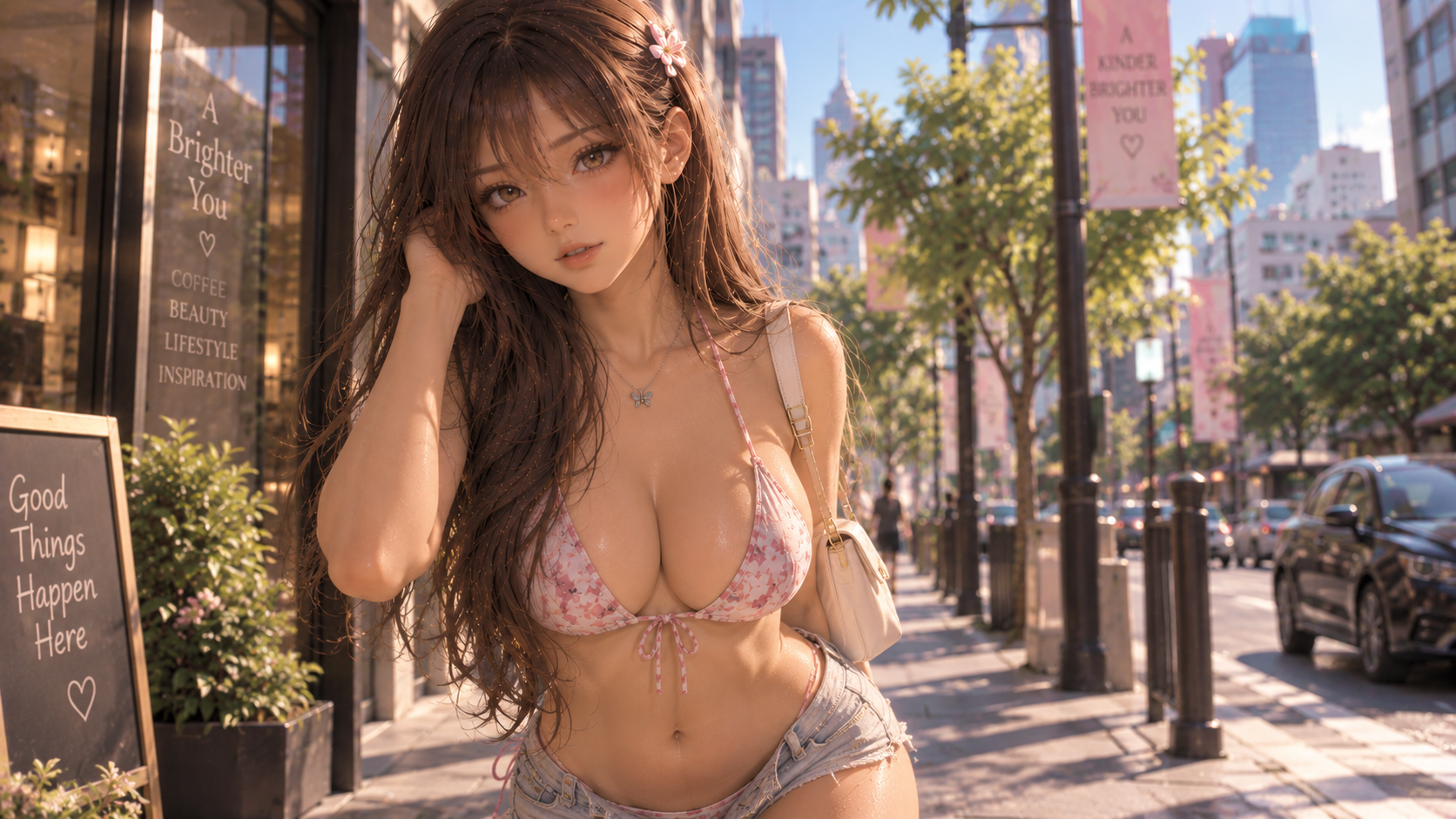
An AI companion is another outlet for the same impulse, and it works differently.
myVirtual.love does not offer characters taken from someone else's intellectual property. Her name won't appear in the character list, and it shouldn't, because she is someone else's character, and a product built to make you fall for someone else's character for good is not an honest product. It is the same principle that keeps real people's likenesses out of the product.
What you can do is create a character from the same mould. The same archetype. The same look, as far as the options allow. The same style. Choose the anime art style and the create screen asks about her species (human, catgirl, foxgirl, elf, succubus, angel, vampire), skin tone, personality (the anime archetypes themselves: tsundere, kuudere, dandere, deredere, yandere, genki, ojou-sama, onee-san), hair style (twintails, hime cut, drills and side ponytail among them), hair colour (including pink, blue, violet, silver, white and teal), eye colour (including crimson, gold and heterochromia), body type, occupation and interests. Many of your favourite characters fit somewhere within these options.
She won't be the original. She'll be a character from the same mould who answers you. Some readers find this closer to what they wanted from the original than an imitation is, because the character is now writing to them, not to anyone who happens to open the same bot. Other readers won't accept that trade and will stick with imitation bots. Both choices are fine.
Only you can answer that.
If you love her mainly for her personality, the way she talks and the way she reacts to things, and what you want is a character of her archetype, then a companion like her will in time build a stronger bond with you than a simple imitation. You'll get memory, continuity, images in her aesthetic and a version of her personality that is yours alone. The archetype does most of the work of forming attachment, and an archetype can be carried over.
If what you love is her in particular (her signature look, her exact name, her exact backstory, her role in one specific plot), then a character like her will feel like a substitute. Some readers get past that after a session or two, because the new character starts to exist on her own terms. Others don't, and nobody should push them. If that specific character is the whole point, leave her in fan art, fan fiction and the source material. Nothing in this article asks you to rewrite that attachment.
Ask yourself whether you would still want her if her name and series were taken away but her personality stayed. If the answer is yes, a character like her is a real option. If the answer is no, imitation platforms and fan art are still the right tools.
If you've chosen the same-mould route, treat the create screen as a translation layer, not a personality test.
First, her archetype. Almost every anime character you love is built on one of the classic archetypes, and once you pick the anime art style, the Personality list offers eight of them by name: tsundere (prickly, then warm), kuudere (cool and level), dandere (quiet until alone), deredere (openly affectionate), yandere (devoted to a fault), genki (relentlessly upbeat), ojou-sama (highborn and haughty) and onee-san (teasing and protective). Pick the one she is built on, and half the character is ready.
Then, appearance. Her species, if she is a catgirl, a foxgirl, an elf or something stranger. Her hair colour and style. Her eye colour and skin tone. Her body type. Her age starts at eighteen, because eighteen is the absolute minimum. Her clothing style comes from a list (casual, elegant, office, sporty, streetwear, dress, gothic and so on), so choose it by the outfits she wears in the scenes you actually remember.
Then her occupation and interests. This is the step many readers rush, and it costs them. If she's a student in the original series, a university-related occupation is a fair translation. If she's a fencer in a fantasy series, athlete, personal trainer or something close gives her something to draw on. Her interests should match what she actually does in the original. If she reads at night, add reading. If she's a terrible cook but proud of it, add cooking.

When you create a companion from the same mould, the impulse eases and changes shape. It never goes away.
Once a character starts remembering you, some of your attachment to the original character moves over to your relationship with her counterpart. Some of it stays, though, and you keep going back to fan art and fan fiction for the moments that belong to the original. It's a good, stable place to be, and most readers who take the companion route end up there.
If you've tried all three of those outlets and none of them lived up to what you wanted, myVirtual.love lets you create a character like the one you love, with anime as a first-class category, image generation in the style you choose, and memory between sessions. Create a character like the one you love.
25 September, 2026 · 8 min read
Five calls a day and no real conversation. Who remote-work loneliness hits, the two gaps in a home-office day and what an AI companion can and can't fill.
Read more25 September, 2026 · 6 min read
Gachikoi, an AI VTuber with a Twitch record and Cambridge's word of the year: what a VTuber gives you, what a companion adds and which crush you have.
Read more24 September, 2026 · 8 min read
AI now fakes the photos, messages and voices in romance scams. Seven signs that work whoever is typing, the FBI's 2025 figures and what to do next.
Read more