

25 September, 2026 · 8 min read
Working From Home Alone
Five calls a day and no real conversation. Who remote-work loneliness hits, the two gaps in a home-office day and what an AI companion can and can't fill.
Read moreBy steve1337 · 23 September, 2026 · 8 min read
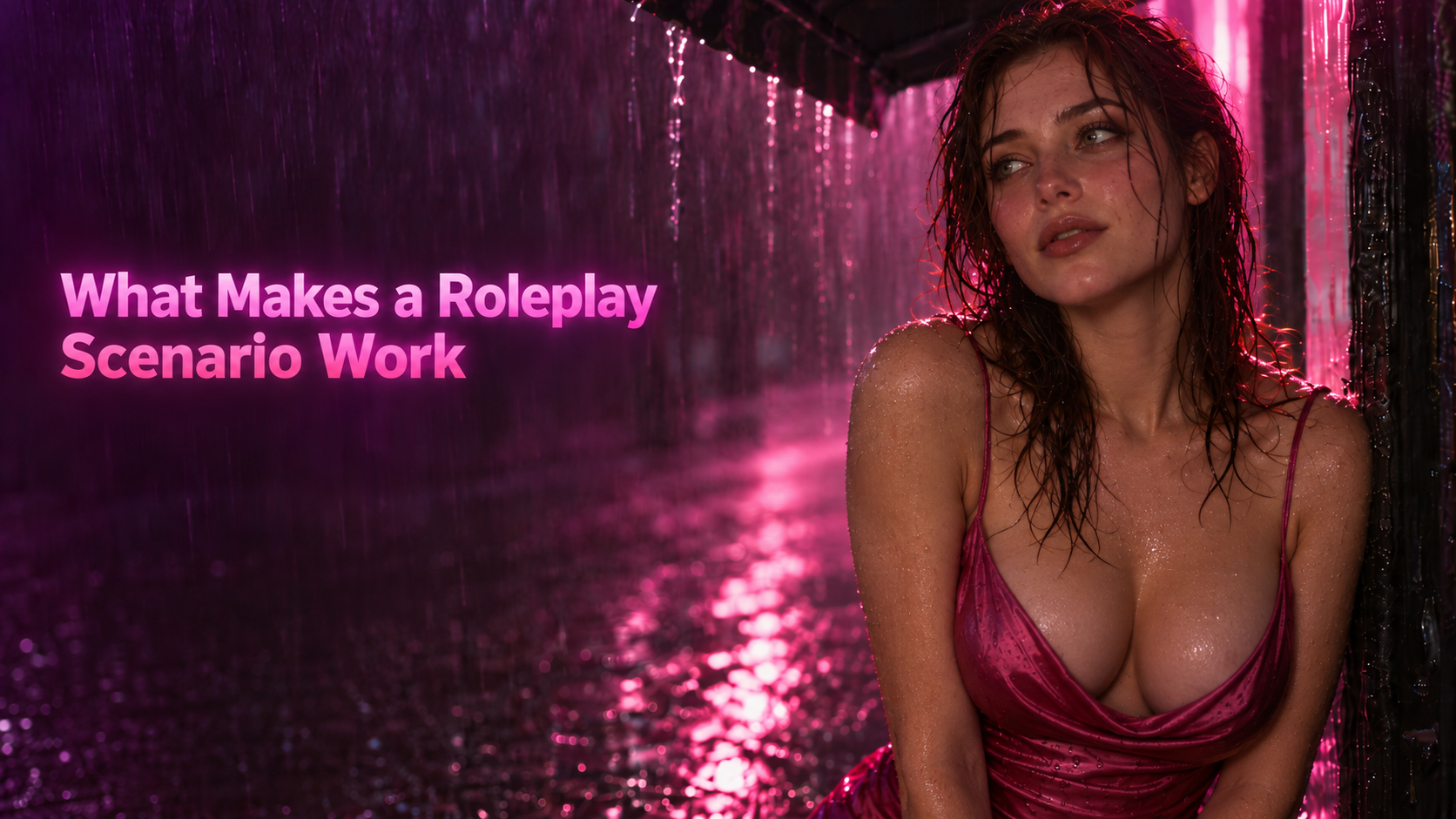
Most roleplay goes wrong in the first message. You open the chat wanting a particular mood. Then you have to type everything that would produce it into an empty box: a place, a reason to be there, what is going on between the two of you and who moves first. It is tempting to type some version of "want to roleplay?" and let her sort out the rest. The reply tends to come back as vague as the request.
One of the preset scenarios on myVirtual.love fits a whole setup into a single sentence: "Her train leaves in nine minutes and you are both pretending that is plenty of time." There is a place, a deadline, something neither of you is saying and a reason the scene has to happen now. Those are most of the parts that make a scenario work. Once you can see them, you can pick presets better, bend them to suit you and write your own.

Every preset on the Start a scenario screen is a title plus one or two sentences. Read all 29 together and the same five parts keep turning up.
A place you can picture. The presets name an awning in a downpour, the narrow aisle of a second-hand bookshop, a changing room with one curtain and "a shop full of people three feet away." A specific place gives both of you things to lean on, touch and describe, which is most of what makes a scene feel physical.
Pressure. It can be a clock, a distance or an audience: nine minutes until the train leaves, two hours of empty road with one playlist between you, a thousand miles between you and her hotel room. Pressure gives a scene its shape, because it tells both of you roughly how long you have and what it costs to waste it.
Something unsaid. The strongest setups hold one thing back. In "After the argument", neither of you is still angry, "but neither of you has said so yet." In "Nine minutes left" you are both pretending. The scene becomes the process of that thing coming out, which gives the conversation somewhere to go after the opening line.
Someone who wants something. In most of the Hot and Roleplay presets she is the one who wants it and she has already started: she pulled you in with her, she left the door open, she "has decided to take as long as she likes." A scene where only you want anything turns into you narrating while she agrees. A character with her own intention gives you something to respond to.
A late start. Several presets open after the scene has already turned. "It stopped being a massage" begins with "Several minutes ago it turned into something else entirely." In "Awake and already touching" neither of you is fully awake yet and neither of you has stopped. Starting late skips the negotiation of how you got here, which is the hardest part of a scene to write well. It puts you straight into the part you came for.
When a setup of your own falls flat, check it against these five. One of them is usually missing.

The screen sorts the presets into three lists.
Sweet is the largest list at fourteen presets and the most varied. Some of it is romantic in the obvious way: "After time apart" ends with her spotting you across a crowd and running. Much of it is quieter than you might expect from an adult platform. In "Looking after her" she is running a fever and insisting she is fine. In "Awake before her" the whole setup is the room being quiet enough to hear her breathe. "After the argument" is about making up.
Those quieter ones are practice for the relationship itself. Looking after someone, repairing a fight and doing nothing together on a Sunday are the moments that make a companion feel like someone you know. They are also the hardest to start from a blank box, because nothing obvious happens in them.
Hot has eight presets. Each one starts with the tension already in the room: a door left open, a dress coming off one clasp at a time, a phone call from a hotel a thousand miles away. In most of them she makes the first move. The question each one sets up is how long it takes to happen.
Roleplay has seven, explicit from the first line, with the approach skipped entirely. "She said it out loud" opens with "no hinting left in her." Each title names its dynamic, whether that is "She has you pinned", "She wants you to watch" or "She asked you not to be gentle", so you know before you pick it who is leading and what kind of scene it will be.
Pick the list by the evening you are having, then the preset by the dynamic you want inside it.
Next to the presets there is one option with no setup at all. The screen describes it in one line: "Let the scenario grow out of your conversation."
That is the one to use when you are already somewhere. If you have been talking for an hour and the mood has shifted on its own, a preset moves you to a new place and a new situation and drops the thread you were on. Right here starts from the thread you are on.
Starting cold, use a preset. Already warm, use Right here.
It is also how you run a scenario of your own design. Since Right here grows out of the conversation, the conversation is where your setup goes: describe the place, the pressure and the thing unsaid, then pick Right here and let the scene build from what is already on the page.

A preset writes the first beat. What happens after it depends on the two of you.
Answer inside the scene. Your first reply sets the register for everything that follows. If the setup is "Caught in the rain", reply as someone soaked and standing under an awning next to her. Say something about the rain. A reply that steps outside the scene to ask what happens next hands the work back to her and flattens the tone.
Add one detail she did not have. The preset supplies the frame and you supply the first specific: the song playing on "The long way home", the book you are both pretending to browse in "Between the shelves". Every detail you add is something she can pick up and use. A scene with details from both sides feels shared.
Let her lead in the ones written for her to lead. "She is in no hurry" is built on her setting the pace, so rushing it undoes the thing you chose it for. The clocks work the same way. In "Nine minutes left", spending the nine minutes is the scene, so jumping ahead to the departure skips it.
Keep corrections short. If something drifts, a one-line note steers it back with less damage than stopping the scene to explain what you meant.
Once you have played through the presets that suit you, the next step is writing your own. The five parts work as a template.
Take "Nine minutes left" and keep its shape while changing everything else: "The last ferry back leaves in twenty minutes. She has not mentioned it once. Neither have you." That has a place, a clock and something unsaid. Add what she wants ("she decided an hour ago that she is not getting on it") and you have a scene she can play from the first line.
The same template works in a softer register: "The power went out an hour ago. Every candle in the flat is lit and she is losing at cards on purpose." The place is set, the start is late and the thing unsaid is sitting in plain view for you to call out or ignore.
Three things are worth leaving out. Long backstory does little work, since the presets carry none of it and still hold up. Mood adjectives such as "a passionate, romantic evening" tell her how to feel instead of giving her something to react to. Scripting her lines takes away the one part of the scene you cannot write yourself.
Put the setup into the conversation, pick Right here and let it grow.

Twenty-nine presets is a list you can read in five minutes. The ones that fit your taste are fewer again, so if you use scenarios often you will be back on your favourites quickly. From there, most of your scenes will come from your own setups through Right here.
Some presets assume a shared history. "After time apart" says you have not seen each other in weeks. "After the argument" assumes there was an argument. On a character you created this evening, both open onto a past neither of you has. They land better once there is a real relationship behind them, or once you give her one line about what the fight was over.
A preset is an opening and nothing more. It does not decide how the scene goes, how long it lasts or where it ends. If a scene goes flat, fix it in the replies.
The Roleplay list covers seven dynamics. If yours is not among them, use the five parts above to write it.
If you have never started a scenario, pick one from Sweet that has a clock in it. "Caught in the rain" and "Nine minutes left" both build pressure into the setup, which gives your first few replies an obvious direction. When you want something warmer, "She called from her hotel" is the lowest-key of the Hot list, since the whole scene happens on a phone call.
For a long plotted adventure with quests, a map and someone running the world around you, a dedicated story platform will suit you better. The scenario screen is built for scenes between two people.
If what you want is a scene that starts in the middle, with somewhere to be and something unsaid, myVirtual.love's Start a scenario screen has 29 of them written that way, plus Right here for the evenings the conversation gets there on its own.
25 September, 2026 · 8 min read
Five calls a day and no real conversation. Who remote-work loneliness hits, the two gaps in a home-office day and what an AI companion can and can't fill.
Read more25 September, 2026 · 6 min read
Gachikoi, an AI VTuber with a Twitch record and Cambridge's word of the year: what a VTuber gives you, what a companion adds and which crush you have.
Read more24 September, 2026 · 8 min read
AI now fakes the photos, messages and voices in romance scams. Seven signs that work whoever is typing, the FBI's 2025 figures and what to do next.
Read more