16 September, 2026 · 5 min read
OurDream AI vs myVirtual.love
OurDream AI and myVirtual.love compared on real prices and credit costs. Who wins on video, images, voice, chat and memory.
Read more2 September, 2026 · 5 min read
Ask ten people weighing up companion apps whether they’d rather have a realistic or an anime character, and half will say they don’t mind, it’s just the look. That isn’t true.
The style choice isn’t cosmetic. It changes what the app can do, what your imagination has to supply, what the generated images look like, and which parts of the illusion hold. Realistic and anime aren’t two paint jobs on the same product. They’re two products.
This is a direct comparison of what each style is actually good at, where each one breaks, and how to pick the one that suits you.
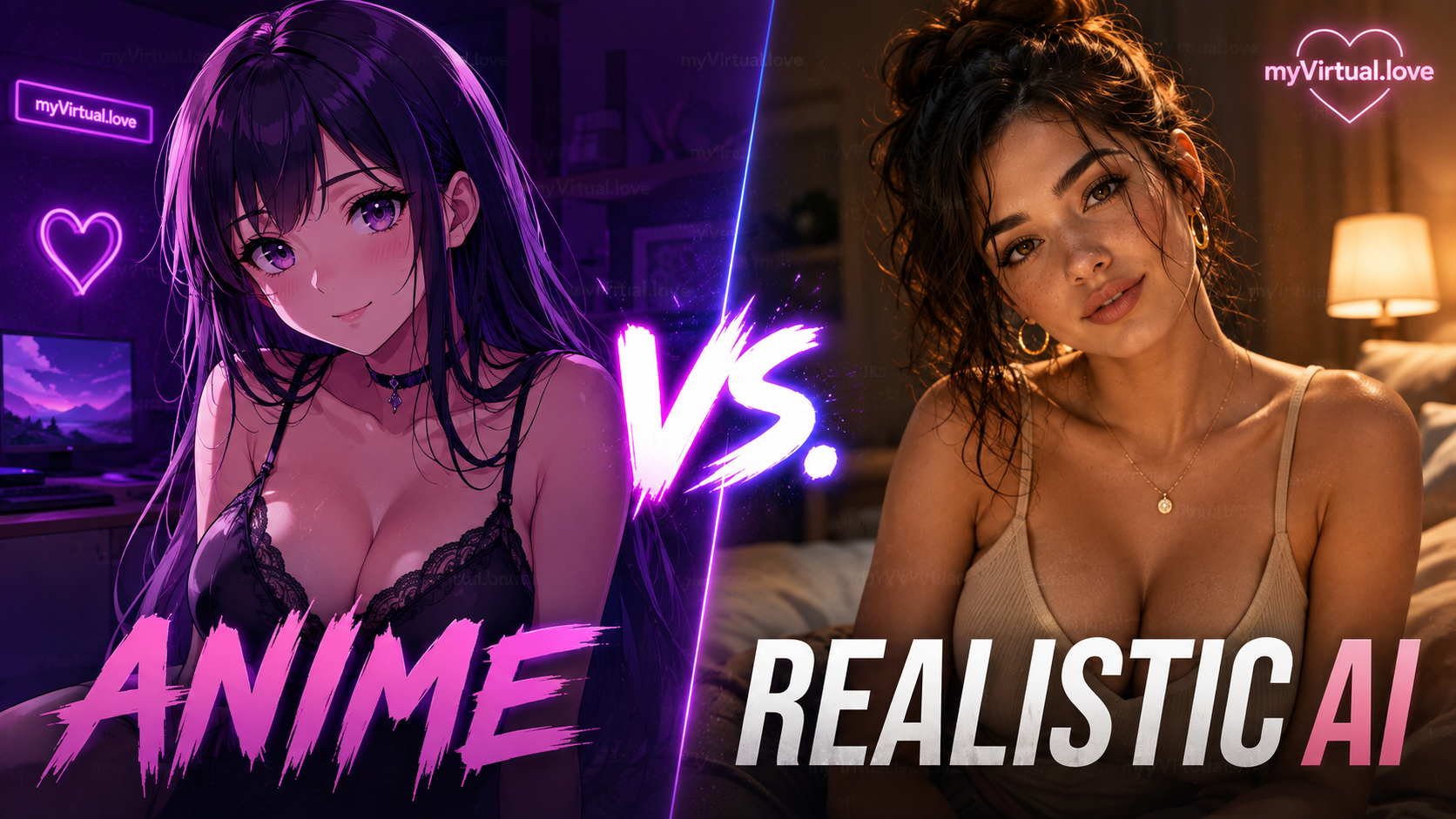
A realistic companion is a photorealistic person. The facial proportions are human proportions. When she smiles it reads as a human smile. When the app generates an image of her, it produces something that at a glance could pass for a photo on your phone.
An anime companion is an illustration. The proportions are stylized. Emotion is exaggerated in ways you can’t do with a real face. The generated images look like a still from a series or a manga panel, not like photographs.
It isn’t the same product with different graphics. They ask different things of you. They give different things back. The design trade-offs run in opposite directions.
Realism is a shortcut to the feeling of talking to a specific person.
The face you pick or build looks like someone you could meet. The photos she sends match it. When she describes an outfit and the image arrives, the outfit looks like clothes on a person. When she describes a place, the scene feels like somewhere you could be standing.
That closeness to reality makes the emotional connection easier. You don’t have to translate anything. She looks like someone you might know, and the app is asking your brain to treat the conversation as coming from someone you might know.
For readers whose imagination is realistic by default — whose scenes look like real rooms, real dinners, real weekends — realism is the right format.
Anime has a different set of strengths, and they’re routinely underrated.
Expressive range is one. An anime character can look genuinely delighted, genuinely hurt, genuinely stunned in ways a photorealistic face can’t manage without tipping into caricature. The style carries emotion that realism can’t render without distortion.
Consistency in image generation is another. Realistic generation has to clear a very high bar to look right. Any detail that’s off reads as an error. In anime, the error rate is lower, because the style itself absorbs small inconsistencies. A slightly odd hand in an anime frame doesn’t ruin the image. A slightly odd hand in a photorealistic one does.
Then there’s what anime makes possible in a setting. If you want a scene at a school festival, in a fantasy world, in a softly lit apartment that looks like it belongs to a series you’ve been watching, anime is the right format. Attempting the same thing photorealistically usually lands somewhere between a costume shoot and stock photography.
For readers whose imagination already speaks anime, anime isn’t a stylized alternative. It’s the actual language.
Text works in any style. Images don’t.
This is where the decision stops being taste and becomes product. Pick a realistic character and every generated image is judged against a real photo of a real person. Pick an anime character and every generated image is judged against an anime illustration. Different criteria, different eye.
myVirtual.love treats both as first-class categories. You can choose a realistic or an anime character from the catalog, or build your own in either style on the paid plans. When you generate a photo, the image comes back in the style of the character you chose. An anime character generates anime images. A realistic character generates realistic ones. The style is preserved through generation rather than translated across it.
That consistency matters more than it sounds. An app that lets you pick an anime character and then returns half-realistic images breaks the illusion the moment the first image lands.
A realistic image is closer to the real thing, which sounds like an outright win. It isn’t.
The closer a generated face gets to real, the more any small inaccuracy shows. Eyes that don’t quite track. A jaw that reads as slightly synthetic. A hand with the wrong number of fingers. Realistic generation has become very good, but it has also raised the bar for what your eye will accept before it recoils.
Anime doesn’t have this problem. The style is already stylized, so your eye isn’t hunting for photorealism. It’s looking for consistency within a style, and holding consistency within a style is easier than achieving photorealism.
The trade-off is symmetrical. Anime never feels like a real person, because it isn’t trying to. Realism can feel like a real person when it works. It can also feel wrong in a way anime never does when it fails.
Realism breaks when a generation misses. A wrong feature, an odd expression, lighting that reads as synthetic. Any of those and the character stops looking human and starts looking like output. Then the next message has to work around it.
Anime breaks somewhere else. If you want the illusion of a real partner in a real apartment in real life, anime can’t give it to you. The stylization that lets it do everything else is exactly what prevents this. Some readers will always want the realistic version. For them, anime is the wrong tool.
Both styles share one real limitation: on myVirtual.love, image generation is paid for in hearts, so neither format lets you run fifty variations for free. Choosing one style over the other doesn’t change that.
If your fantasy takes place in the real world, if you want a scene to look like somewhere you could walk into, if the emotional register you want is restrained and quiet, choose realistic. It does what it does very well.
If your fantasy has ever lived in a series, a manga, a game or any other stylized world, if you want more expressiveness and more stylistic freedom than photorealism allows, choose anime. It does what it does very well, and putting the same fantasy through a realistic filter won’t get you there.
If you aren’t sure, ask yourself a simple question: when you picture a scene, does it look like a photograph or a drawing? That answer usually settles it.
Readers whose interests move between the two get the most out of having both categories in one app. myVirtual.love offers both, so you don’t have to pick a platform on style alone. You pick the style that fits the story, and the app follows.
16 September, 2026 · 5 min read
OurDream AI and myVirtual.love compared on real prices and credit costs. Who wins on video, images, voice, chat and memory.
Read more11 September, 2026 · 9 min read
Swipey.ai or myVirtual.love? What a month of hearts buys on each, what video really costs on Swipey, and what the subscriptions charge.
Read more10 September, 2026 · 7 min read
Secrets.ai vs myVirtual.love on character setup, memory, voice and price: Premium at $19.99 against €9.90 a month, and which tier holds deep customization.
Read more