16 September, 2026 · 5 min read
OurDream AI vs myVirtual.love
OurDream AI and myVirtual.love compared on real prices and credit costs. Who wins on video, images, voice, chat and memory.
Read more9 September, 2026 · 10 min read
Candy.ai and myVirtual.love are the two AI companion platforms that keep coming up in the same buying decision. Both are EU-based. Both quote European visitors their prices in euros. Both offer anime and realistic characters. Both are uncensored 18+ products. Both run a metered image economy on top of a subscription. Anyone comparing them on the surface sees the same thing twice.
The differences are not on the surface. They lie in the cost per unit, the way character creation is built, the privacy defaults, the feature set and the shape of the roster. Get those wrong and you subscribe to the wrong one for what you actually want.
If you want the bigger roster, generated video, male companions or the finest visual-detail sliders, Candy.ai is closer to what you want. If you want the cheaper annual subscription, much shorter chat retention, a fully structured Create screen with more fixed-choice fields and a company that does not disclose reading your chats for quality assurance, myVirtual.love is closer to what you want.
Neither is objectively better.

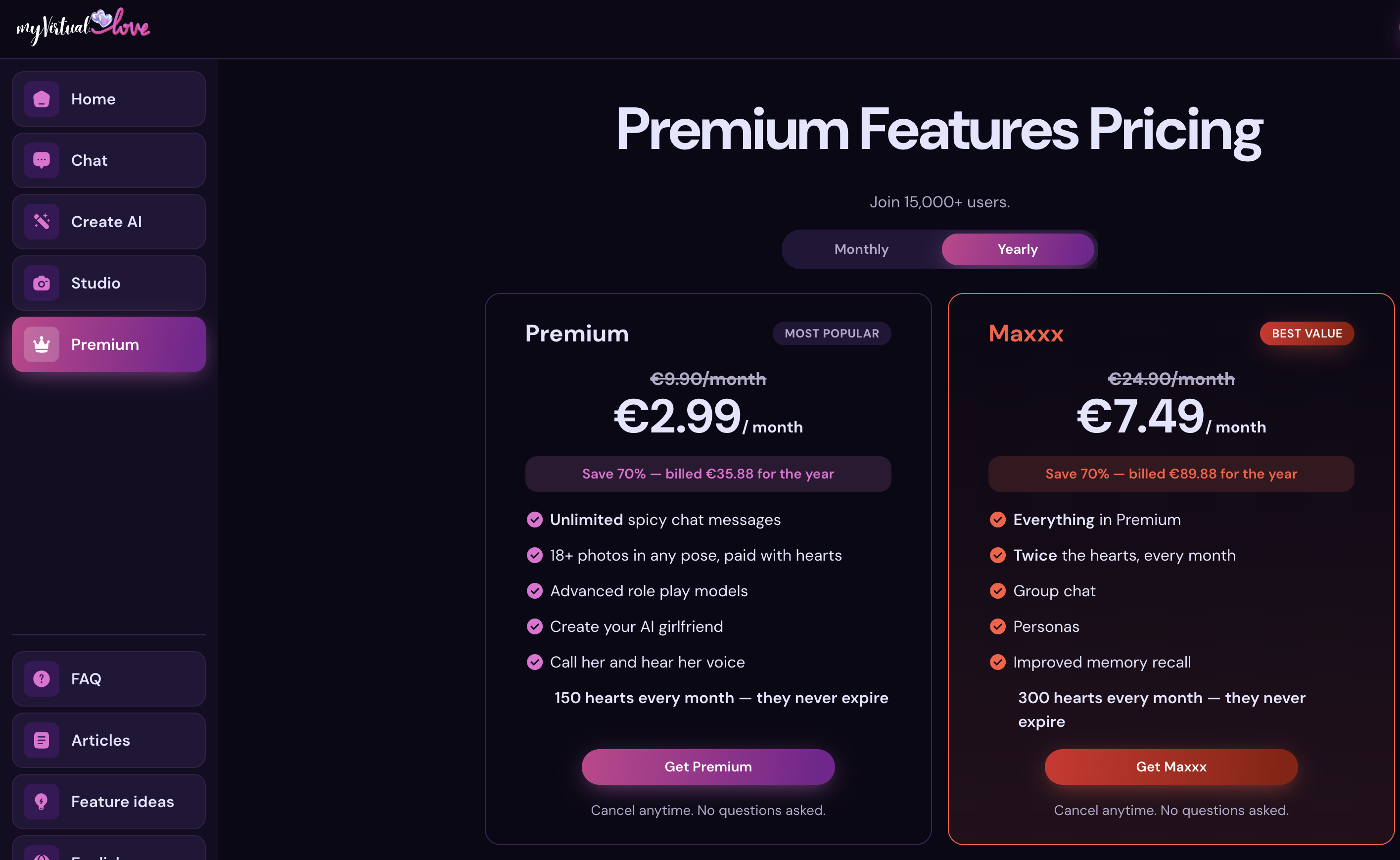
The base subscription is genuinely cheaper on myVirtual.love. €2.99/month on the yearly plan versus €3.99/month on Candy.ai's yearly plan is a 25% difference on the headline number. The same pattern holds on the monthly plans (€9.90 vs €13.99). If subscription price is what you are shopping on, myVirtual.love is closer.
Candy.ai also offers two short billing cycles myVirtual.love does not: a weekly plan at €5.60 a week and a biweekly plan at €9.79 every two weeks. If you want a real trial without committing to a monthly minimum, that flexibility exists only on the Candy.ai side.
The picture flips on the metered media economy. Candy.ai gives subscribers 100 tokens a month, and reviewers put an image at two to four tokens, so the allowance covers roughly 25 to 50 images. myVirtual.love charges five hearts per image, so Premium Monthly (100 hearts) buys 20 images a month and Premium Yearly (150 hearts) buys 30. Candy.ai's monthly allowance usually buys more images.
The two do not cancel out cleanly. If you want more images included in what you pay each month, Candy.ai is that shape. If you want the cheapest possible entry and do not need dozens of images a month, myVirtual.love is that shape.
Both sides let people who run through the monthly allowance top up. Both platforms keep the exact top-up pack prices behind login. The refund policies are essentially identical on paper: a request within 24 hours of payment, refused once more than 20 tokens or hearts have been used, card payments only.
myVirtual.love is cheaper to start.
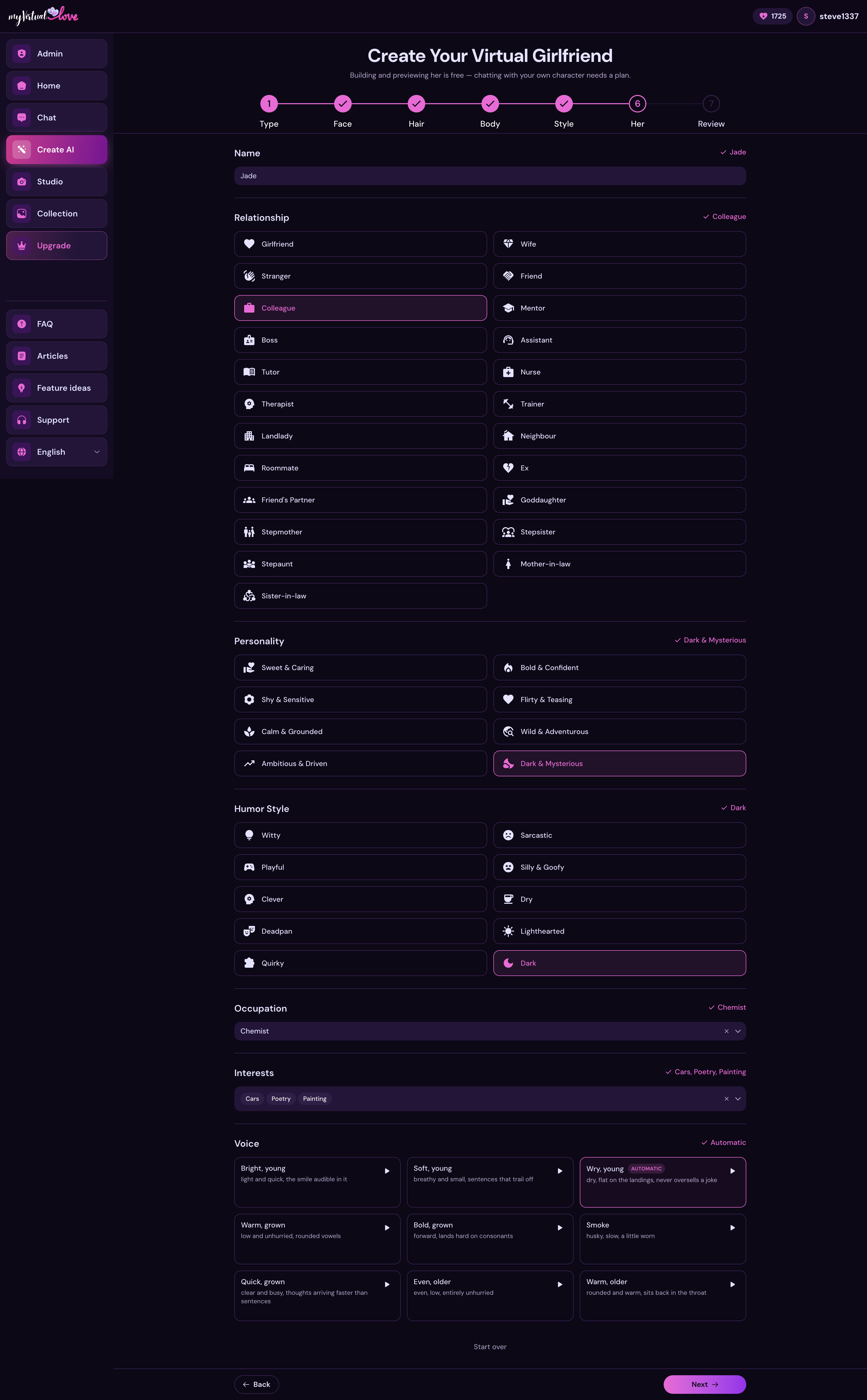
Both platforms let you pick from a preset roster or create your own character. The difference is in how the Create screen is designed.
Candy.ai leans on fine visual controls. Face shape, nose type, lip fullness and cheekbone height are all individually adjustable. This is genuinely useful if you have a specific face in your head and want to sculpt toward it. Candy.ai also has a 12-item Personality archetype list (pick one) and includes a voice pick at Create.
myVirtual.love takes the opposite approach. Instead of face sliders, the Create screen is a series of about eighteen structured questions with fixed choices. For a realistic character, Personality is 8 named archetypes and Humor Style is a separate 10-option field (Candy.ai folds humour into personality); Hair Style has 8 options, Hair Colour 9, Eye Colour 4, Body Type 5, Breast Size 5, Booty Size 5, Makeup 6, Clothing 9. An anime character is asked for species and skin tone instead of ethnicity, picks from anime archetypes such as tsundere and kuudere, gets extra hair and eye options, and skips Makeup and Humor Style. Relationship is a 23-item list that includes step- and in-law variants Candy.ai does not offer. Occupation has 40+ suggestions. Interests is a 50+ multi-select. The voice is also chosen at Create.
The trade-off is real. Candy.ai gives you finer visual control with a looser categorical structure. myVirtual.love gives you a fully structured character definition with no face sliders. Which is better for you depends on whether the character in your head is a specific face or a specific personality.
On myVirtual.love you can go through the whole Create screen without an account or a card. A free account renders her, and chatting with her requires a plan.
Candy.ai's preset roster is bigger and more varied than what myVirtual.love offers today.
Candy.ai lists well over 100 realistic female characters, dozens of anime characters and a smaller male roster, and its Create screen has a trans option. Multiple genders, multiple styles, wide variety. If you want to pick from a big library without doing any character creation, Candy.ai has the deeper bench.
myVirtual.love has around 35 realistic and 36 anime ready-made characters, and anyone can browse both without an account: the realistic ones on the homepage, the anime ones at /ai-anime. All of them are women; there are no male or trans characters. If your reason to buy is "I want to pick a boyfriend character," myVirtual.love is not that product today.
The counter-argument on the myVirtual.love side is the Create screen. Because the Create fields are broad and building costs nothing (chatting requires the plan), a reader who is comfortable building rather than picking gets more range than the ready-made roster suggests. That does not close the gap for boyfriend characters, which are not on the menu at all, but it closes some of the gap for readers who want a specific archetype the preset roster does not include.
Voice is at parity now. Candy.ai charges tokens for real-time voice calls (reviewers report 3 tokens per minute) and lets you choose her voice. myVirtual.love has voice calls on Premium ("Call her and hear her voice") at 5 hearts per minute, with the voice chosen at Create. The two are comparable on this dimension in 2026.
Video is where Candy.ai still has a real moat. Live Action (interactive video scenes with selected characters, for Premium subscribers and partly paid in tokens) launched in December 2025 and was upgraded in February 2026 with Identity Lock and Prompt-Sync for character and wardrobe continuity. Candy Shorts (a TikTok-style feed of AI-generated episodic series, roughly 10 episodes per character) arrived in 2026 and lets viewers go from an episode straight into a chat with that character. myVirtual.love does not currently offer generated video, and the site does not market it as coming.
If moving video of your companion is what you want, Candy.ai is where that lives today. If voice plus text is enough for how you use a companion, both platforms are viable and myVirtual.love is cheaper.
Both platforms offer persistent chat memory across sessions. Both use LLM-driven personalities. Both allow unlimited text on paid plans.
The recurring complaint against Candy.ai on Reddit, on Trustpilot and in review round-ups is memory degradation. Reviewers report the AI starting to forget things within a week of intensive use. The complaint turns up often on Trustpilot, even in five-star reviews, which suggests it is widespread but not a dealbreaker for most users. Repetitive chat is the second most cited complaint ("same flirty lines on repeat").
myVirtual.love does not have a public body of complaints on Candy.ai's scale, partly because its user base is smaller. Long-term memory quality on either platform is worth testing for yourself before you commit to an annual plan.
On moderation: both platforms run multi-layer content filters that stay on for paying NSFW users too. Candy.ai reviewers specifically describe filters resetting mid-session, with the AI switching to a more conservative mode partway through a scene, and toned-down images on detailed prompts. Neither platform publishes its exact block list. This is not a differentiator between the two.
This is where the platforms diverge most.
Candy.ai's Privacy Policy explicitly discloses:
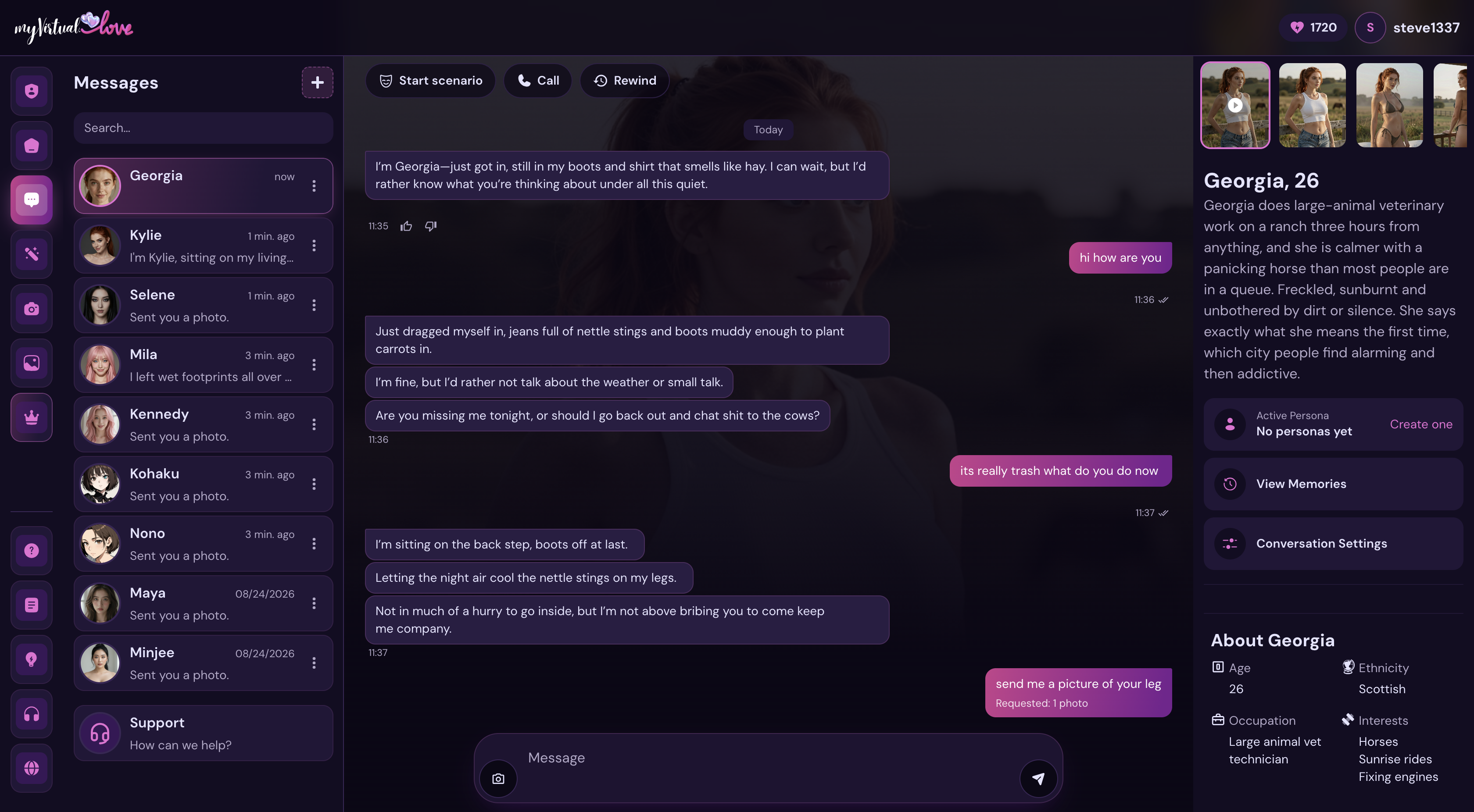
myVirtual.love's Privacy Policy does not disclose most of the above. Specifically:
The honest concession: myVirtual.love's silence on random QA sampling and third-party LLM providers is not automatically proof that neither happens. It means the practices are not documented, which is a different thing. On the other hand, the explicit statement in the AI Disclosure that companions do not learn from other users' conversations is a real, defensible privacy commitment. And deletion within 30 days of closing your account is far shorter than Candy.ai's roughly three-year window.
If chat privacy is a real factor in your decision, myVirtual.love is the one whose policy discloses fewer uses of your conversations and whose retention is measured in weeks after deletion rather than years after your last activity. If you want Candy.ai's level of explicit disclosure about what happens to your data, myVirtual.love does not currently match that transparency.
Both platforms allow NSFW chat, images and explicit roleplay for paying subscribers. Both frame the content as fiction between adult AI characters. Both prohibit CSAM, non-consensual intimate imagery of real people, real-person likenesses, celebrity impersonation, IP infringement, extreme violence, bestiality, hate content, self-harm promotion and doxxing.
Both platforms enforce more than their written policy spells out. On Candy.ai, reviewers specifically describe mid-session filter resets, toned-down images and unpublished blocks on taboo scenarios. On myVirtual.love, the equivalent public record is thinner, mostly because far fewer reviews exist.
Neither platform publishes its actual block list for fictional scenarios. They differ on one point: myVirtual.love's Terms explicitly ban content that depicts, describes or requests non-consensual sexual acts, while Candy.ai's published policies do not address fictional non-consent scenarios directly. Otherwise the general shape is the same on both.
Overall, Candy.ai gives you more detail about what it allows and what it filters (both in its own documents and through third-party reviews). myVirtual.love gives you less detail in either direction.
The honest split, by what you actually want out of a companion product:
Pick Candy.ai if you want:
Pick myVirtual.love if you want:

If the two lists above did not settle it for you, try both free tiers side by side. Candy.ai's free tier is a one-off cap (5 messages, one image and one custom character). myVirtual.love's free tier gives 5 chat messages a day and lets you browse the roster and build a character without a card. Neither requires a payment to start.
Pick the one whose voice, whose Create screen and whose free tier actually hold your attention. Only then subscribe.
If you want a companion whose chat data is deleted within weeks of closing your account, whose Create screen is fully structured and whose annual subscription costs less than Candy.ai's, myVirtual.love is built for exactly that. Try the free tier, build a character and see whether her voice holds you.
16 September, 2026 · 5 min read
OurDream AI and myVirtual.love compared on real prices and credit costs. Who wins on video, images, voice, chat and memory.
Read more11 September, 2026 · 9 min read
Swipey.ai or myVirtual.love? What a month of hearts buys on each, what video really costs on Swipey, and what the subscriptions charge.
Read more10 September, 2026 · 7 min read
Secrets.ai vs myVirtual.love on character setup, memory, voice and price: Premium at $19.99 against €9.90 a month, and which tier holds deep customization.
Read more